
Overview of the Green Innovation Fund Projects
In October 2020, Japan declared that it aims to achieve carbon neutrality by 2050, with the goal of reducing overall greenhouse gas emissions to zero by this year. Carbon neutrality by 2050 cannot be realized through ordinary efforts. It is necessary to significantly accelerate efforts toward structural changes in the energy and industrial sectors, and undertake bold investment for innovation.
For this reason, the Ministry of Economy, Trade and Industry (METI), in collaboration with other ministries and agencies, formulated the “Green Growth Strategy through Achieving Carbon Neutrality in 2050.”
The strategy specifies 14 promising areas expected to demonstrate future growth and provides action plans for each of these areas from the viewpoints of both industrial and energy policies. The strategy reflects Japan’s determination to pursue ambitious goals while highlighting to the greatest extent possible realistic pathways toward their achievement. Moreover, to support the forward-looking efforts of companies aiming to realize these goals, many kinds of policy measures are being mobilized. As part of this effort, a 2 trillion yen* fund has been established at NEDO in March 2021 to launch the Green Innovation Fund Projects.
*300 billion yen was added to the second supplementary budget for FY2022, and 456.4 billion yen was added to the initial budget for FY2023, bringing the total to 2.7564 trillion yen as of November 2024
Logo

The logo visually integrates the two key elements — “G” and “I” — from the Green Innovation Fund Projects.
Its leftward arrow evokes acceleration and circular flow. By combining a fluid, organically shaped curve with a precise rectangular form, the design expresses the fusion of nature and technology.
The color palette — green representing carbon neutrality and blue symbolizing industry and innovation — conveys the harmony and growth that emerge when these forces evolve together.
Basic Policies for Green Innovation Fund (Summary)
01Purpose and Outline
To achieve carbon neutrality by 2050, METI established a 2 trillion-yen fund as part of NEDO and provide continuous support for R&D projects, demonstrations, and social implementation projects for up to 10 years to companies that commit to ambitious goals.
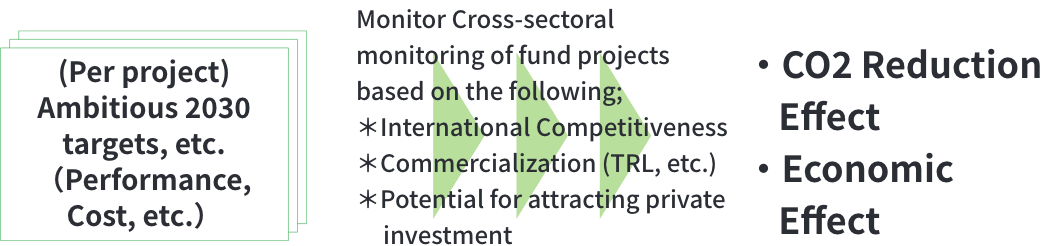
02Program Target
03Support Target
METI’s support will focus on priority fields for which implementation plans have been formulated within the Green Growth Strategy, or key fields for which a future roadmap has been presented based on the “Basic Policy for Realization of GX”, where policy effects are significant, and long-term continuous support is required to realize public implementation.
- Average size of conventional R&D projects (20 billion yen) or more.
- Projects for which short-term government support programs is sufficient are not eligible.
- Main implementers should be companies or other profit-making businesses capable of carrying out the entire process of public implementation (participation of small and medium-sized venture companies is encouraged; participation of universities and research institutions is also expected).
- The project must include innovative and fundamental R&D elements that are worthy of being commissioned by the government.
04Strategy for Maximizing Results
To ensure that research and development results are steadily implemented publicly, METI seeks the commitment of the managers of companies and other organizations to persevere in challenging these goals as long-term business issues.
Efforts required of company managers
- Submission of the vision and the long-term business strategy at the time of application
- Attendance and report to the WG
- Submission of a management sheet showing the status of initiatives
Implementation of a system to enhance commitment
- If the status of the project is inadequate, the project will be canceled, and a portion of the consignment fee will be returned.
- Introduction of a system(an incentive measure)that allows the government to pay more depending on the degree of achievement of targets.
05Scheme
Build a highly transparent and effective governance system that incorporates the knowledge of external experts and close cooperation among related organizations.
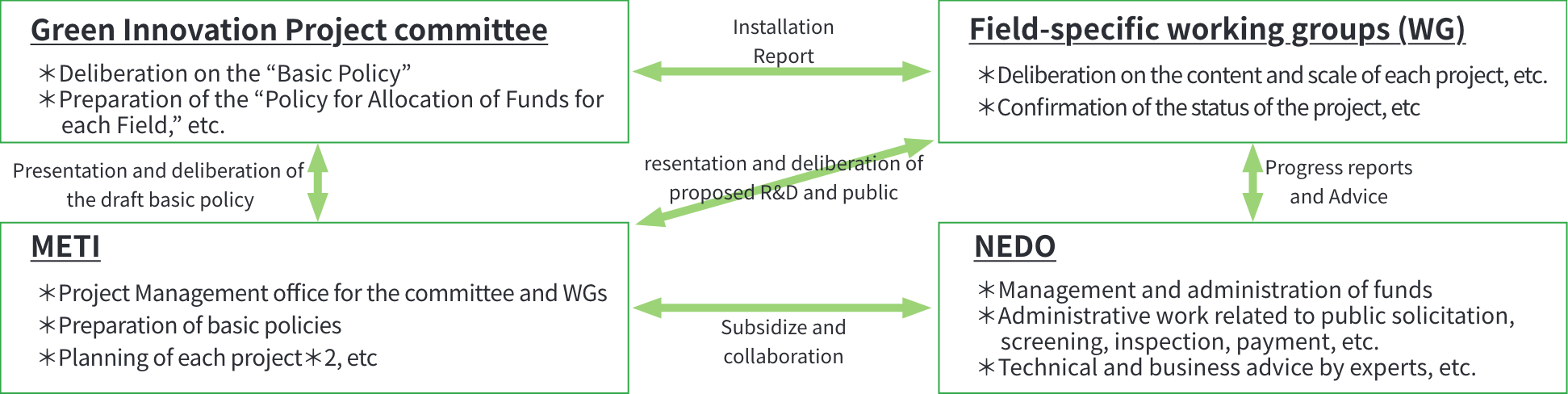
※1 A plan describing the project’s goals for 2030, R&D items, maturity level of the target technologies(TRL, etc.), budget scale, etc. (A draft of the plan is discussed by the WG.)
※2 Including the division office in charge of the project in the relevant ministry or agency.
06Program Schedule

14 priority fields for which implementation plans have been formulated within the Green Growth Strategy
Energy related industries

(Next-generation renewable energy)


* NEDO does not possess legal authority to carry out or support R&D activities that exclusively target nuclear power.
Transport/manufacturing industries







Home/Office related industries



Green Growth Strategy Through Achieving Carbon Neutrality in 2050(METI)