
A Major Step Toward the Practical Use of Hydrogen-Fueled Ships Using a Liquefied Hydrogen Fuel Supply System
World’s First Onshore Operation of a Marine Hydrogen Engine Successfully Completed


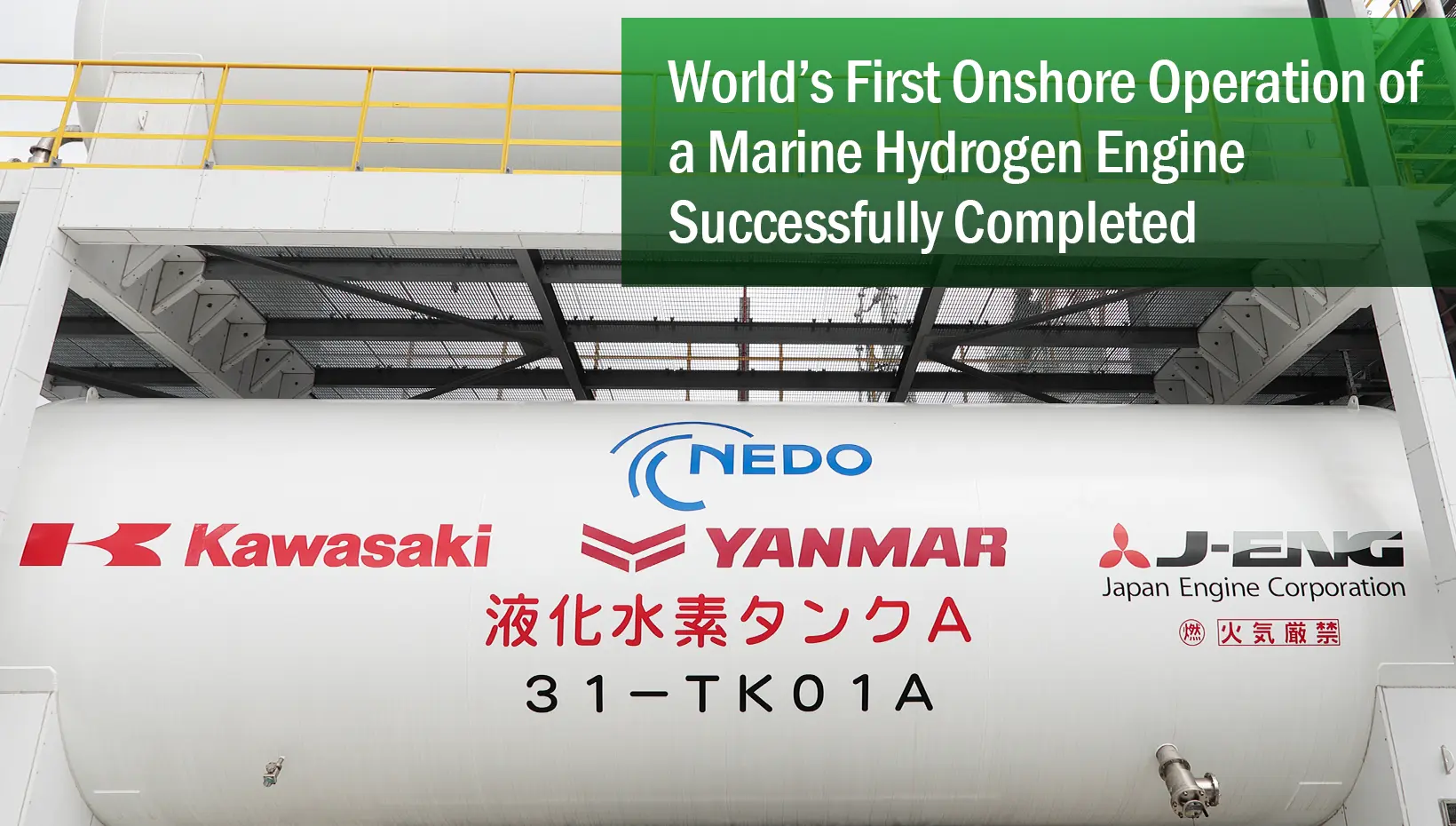
Japan is making steady progress toward the practical use of hydrogen-fueled ships. Under NEDO’s Green Innovation (GI) Fund Projects “Next-generation Ship Development,” three domestic marine engine manufacturers—Kawasaki Heavy Industries, Ltd., Yanmar Power Solutions Co., Ltd., and Japan Engine Corporation—have formed a consortium to accelerate research and development aimed at the social implementation of hydrogen-fueled ships. At the “Hydrogen Fuel Supply Equipment and Marine Hydrogen Engine Demonstration Launch Event,” held in October 2025, the project presented its progress by publicly conducting the world’s first onshore operation of a marine hydrogen engine, using a liquefied hydrogen fuel supply system under demonstration.

Ribbon-cutting ceremony at the launch event. From left: Masaru Hirose, President and Representative Director, Yanmar Power Solutions Co., Ltd.; Shintaro Matsumoto, Executive Director, NEDO; Takuya Fukumoto, Deputy Director-General for GX Policy, Ministry of Economy, Trade and Industry (METI); Jun Kohno, Senior Deputy Director-General, Maritime Bureau, Ministry of Land, Infrastructure, Transport and Tourism (MLIT); Motohiko Nishimura, Senior Managing Executive Officer and President, Energy Solution & Marine Engineering Company, Kawasaki Heavy Industries, Ltd.; and Ken Kawashima, President, Japan Engine Corporation.
As part of NEDO’s “Next-generation Ship Development” initiative, work is underway to develop a marine hydrogen engine and to carry out demonstration voyages of hydrogen-fueled ships by fiscal 2030. The initiative also covers the development of the Marine Hydrogen Fuel Tank and Fuel Supply System (MHFS), which integrates marine hydrogen fuel tanks with a supply system that delivers hydrogen to the engine.
Three Engine Manufacturers Working Together to Drive Innovation
Growing calls for decarbonization now extend to the maritime sector. In 2023, the International Maritime Organization (IMO) adopted its “Strategy on Reducing Greenhouse Gas Emissions,” which calls for achieving net-zero GHG emissions by around 2050. As interim targets, the strategy sets internationally agreed goals to reduce emissions by 20–30% by 2030 and by 70–80% by 2040, compared with 2008 levels.
Hydrogen is emerging as a key energy option for achieving these targets. Yet no large hydrogen-fueled vessels are in regular operation anywhere in the world, and countries continue to develop the technologies needed for practical use.
At the start of the launch event, Motohiko Nishimura, Senior Managing Executive Officer and President of the Energy Solution & Marine Engineering Company of Kawasaki Heavy Industries, Ltd., emphasized the significance of the GI Fund Projects, stating, “This demonstration shows that Japan is taking the lead in the global effort to decarbonize shipping.” He added that “the collaboration of three marine engine manufacturers, bringing their technologies together, is something rarely seen internationally,” noting that this level of cooperation is unusual even in the global maritime industry.

Motohiko Nishimura, Senior Managing Executive Officer and President, Energy Solution & Marine Engineering Company, Kawasaki Heavy Industries, Ltd.
Reducing greenhouse gas emissions, including CO2, is far from easy. According to the International Energy Agency (IEA), about 46% of the emissions reductions needed to reach net-zero CO2 by 2050 will depend on technologies that do not yet exist.
In his remarks, Takuya Fukumoto, Deputy Director-General for GX Policy at the Ministry of Economy, Trade and Industry (METI), stressed the importance of innovation. He commended the three companies for taking on this challenge together and noted that METI is committed to supporting these efforts through the GI Fund Projects.

Takuya Fukumoto, Deputy Director-General for GX Policy at the Ministry of Economy, Trade and Industry (METI)
The Next-generation Ship Development initiative under the GI Fund Projects seeks to position Japan as a global leader in decarbonizing the maritime sector. In his remarks, Jun Kohno, Senior Deputy Director-General of the Maritime Bureau at the Ministry of Land, Infrastructure, Transport and Tourism (MLIT), noted that the bureau has established a “Study Group on Transforming the Shipbuilding Industry.” Its report sets a goal for Japan to secure the world’s largest share of orders for next-generation vessels by 2030. The technologies unveiled at the launch event demonstrate steady progress toward achieving that goal.

Jun Kohno, Senior Deputy Director-General of the Maritime Bureau at the Ministry of Land, Infrastructure, Transport and Tourism (MLIT)
MHFS Begins Operation: Key to Hydrogen Engine Development
Kawasaki Heavy Industries, Yanmar Power Solutions, and Japan Engine Corporation are each developing hydrogen engines in their respective size and power ranges, reflecting their engineering strengths, as part of the Hydrogen-Fueled Ships and MHFS Development initiative. The initiative’s primary goal is to complete demonstration voyages of hydrogen-fueled ships equipped with these engines by fiscal 2030. In addition, Kawasaki Heavy Industries is building the MHFS, a system that delivers hydrogen to the engines.
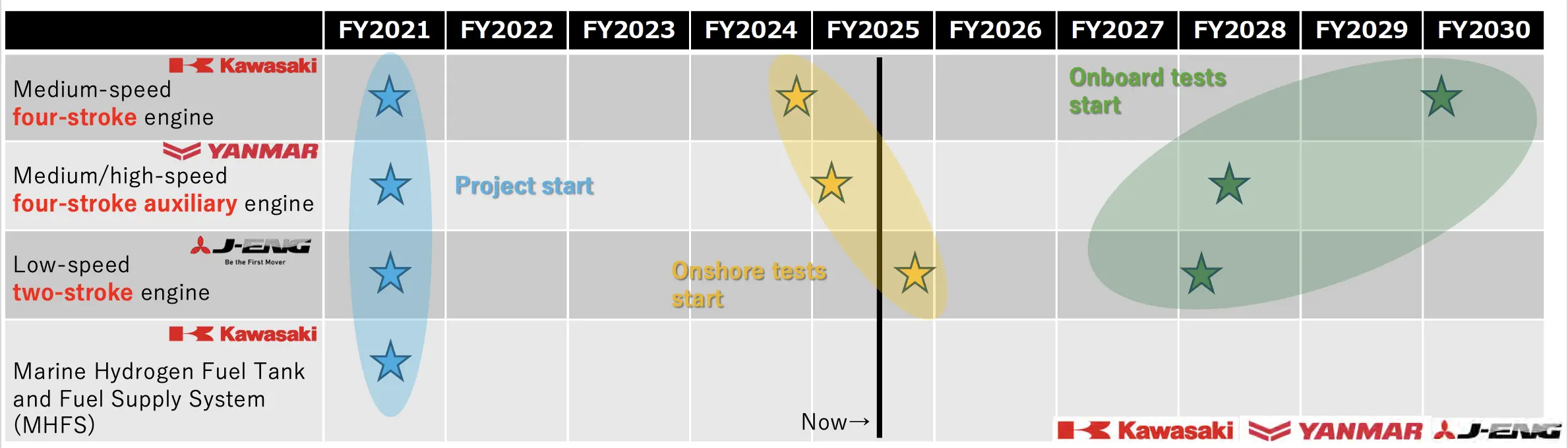
Milestones for Hydrogen-Fueled Ships and MHFS Development
Starting in March 2021, the effort has focused on onshore demonstration tests of hydrogen engines. Kawasaki Heavy Industries and Yanmar Power Solutions have already launched these tests, while Japan Engine Corporation has completed the manufacture of a large hydrogen engine and is set to begin onshore demonstration testing in spring 2026. Regarding onboard demonstration tests, Yanmar Power Solutions and Japan Engine Corporation are scheduled to conduct trials in fiscal 2028, followed by Kawasaki Heavy Industries in fiscal 2030.

Hydrogen fuel supply system for onshore demonstration tests
For the MHFS, the goal is to develop the system in preparation for onboard demonstration tests by Yanmar Power Solutions and Japan Engine Corporation. To support this effort, an onshore demonstration system has been installed and is now in operation.
At the launch event, the onshore hydrogen fuel supply system at Japan Engine Corporation’s main plant and the hydrogen engines developed by Kawasaki Heavy Industries and Yanmar Power Solutions were presented. The system, prepared for joint use by the three companies, supplies hydrogen via steel piping to the engines used for onshore demonstration tests.
The hydrogen fuel supply system is equipped with two tanks, each capable of storing 70 m3 of liquefied hydrogen. Using a liquefied hydrogen pump, the fuel is pressurized to a maximum of 30 MPa, then vaporized before being supplied as hydrogen gas to the engines. The system can supply up to 781 kg of hydrogen per hour, enabling onshore testing of up to three engines simultaneously, with a delivery temperature range of 0 to 50°C.
Chiharu Kawakita, Ph.D., Deputy Director General of Hydrogen and Ammonia Department and Project Manager of GI Fund Projects (Next-generation Ship Development) at NEDO, described the newly commissioned onshore hydrogen fuel supply system as “a core element of the project as it moves forward.” The facility, capable of delivering large volumes of hydrogen at pressures up to 30 MPa, represents one of the most advanced testing systems in the world. It supplies hydrogen safely and reliably in line with the diverse requirements of each company’s demonstration engines, and as Kawakita noted, “will significantly accelerate upcoming demonstration trials and further technological development.”

Chiharu Kawakita, Project Manager of GI Fund Projects ( Next-generation Ship Development) at NEDO
Progress on Challenges in Hydrogen Engine Development
Developing marine hydrogen engines involves several technical challenges that must be addressed. Among the most significant are the wide flammability range and low ignition energy of hydrogen, which make abnormal combustion more likely; the risk of hydrogen embrittlement, in which metals become brittle when absorbing hydrogen; and the tendency of hydrogen to leak due to its small molecular size, requiring robust preventive measures. The three marine engine manufacturers are developing technologies to manage these challenges and are validating their performance through onshore demonstration testing.
The hydrogen engine presented by Kawasaki Heavy Industries is a medium-speed, four-stroke engine equipped with eight cylinders and a rated output of 2,600 kW. The company plans to increase output in the future and adjust the number of cylinders, enabling a single engine to reach up to 8 MW. With multiple engines installed, total output could reach around 30 MW, making the system suitable for vessels ranging from small coastal ships of about 100 meters in length to large oceangoing vessels of around 300 meters.

Kawasaki Heavy Industries’ medium-speed, four-stroke hydrogen engine (Photo courtesy of Kawasaki Heavy Industries)
A key feature of Kawasaki Heavy Industries’ engine is its exhaust gas recirculation (EGR) system. By returning a portion of the exhaust gas to the intake side to lower the oxygen concentration, the system helps moderate the rapid combustion characteristics of hydrogen. The current test engine is a dual-fuel (DF) unit that uses diesel fuel during startup and then transitions to hydrogen operation. Testing has confirmed that the hydrogen substitution ratio can be raised to as high as 98 percent.
The hydrogen engine demonstrated by Yanmar Power Solutions is also a medium-speed, four-stroke engine, similar to Kawasaki Heavy Industries’ model, and is planned for installation as a generator engine on an oil tanker for the demonstration voyage. It is equipped with six cylinders and has a rated output of 800 kW. Like Kawasaki’s engine, it uses a dual-fuel system that provides operational redundancy. The engine is also fitted with Yanmar’s own selective catalytic reduction (SCR) system to reduce NOx emissions.

Yanmar Power Solutions’ medium-speed, four-stroke hydrogen engine (Photo courtesy of Yanmar Power Solutions)
Yanmar Power Solutions began demonstration testing of a multi-cylinder, hydrogen-fueled engine in July 2025. A hydrogen fuel substitution ratio of up to 96% was achieved under practical load conditions. Prior to this stage, CFD (Computational Fluid Dynamics) analysis was used to model air-hydrogen mixture formation and hydrogen combustion. Control strategies to prevent abnormal combustion were also developed, using a single-cylinder test engine with the same bore as the multi-cylinder engine.
Japan Engine Corporation plans to begin testing its hydrogen engine in spring 2026. The engine is a low-speed, two-stroke model intended for use as the main engine on multipurpose cargo vessels. To ensure stable operation, the company has developed a hydrogen combustion analysis model that enables performance simulation and prevents abnormal combustion.
For this two-stroke engine, hydrogen gas is injected at high pressure (30 MPa). Japan Engine Corporation manufactured a dedicated high-pressure hydrogen injection unit and conducted durability tests under high-pressure hydrogen for ten million cycles, confirming that no hydrogen embrittlement occurred. With reliability secured, the company has begun assembling the engine, which is expected to deliver a maximum output of 5,610 kW.

Low-speed, two-stroke hydrogen engine under development by Japan Engine Corporation (image courtesy of Japan Engine Corporation)
Research and development on hydrogen engines by the three manufacturers is making steady progress. However, engine development alone is not enough to bring hydrogen-fueled vessels into practical use; the upcoming onboard demonstration trials will be even more critical. From the standpoint of enabling broader social adoption, the development of efficient hydrogen bunkering systems will also be essential. In addition, lowering the cost of hydrogen remains a key requirement, and achieving these goals will demand coordinated efforts across industry sectors. While the challenges are substantial, NEDO continues to support efforts that will enable Japanese technologies to contribute to the decarbonization of the maritime sector.
*Note Bunkering—the process of supplying hydrogen fuel to a hydrogen engine—presents several challenges. Because liquefied hydrogen must be handled at extremely low temperatures, the operational sequence is complex, and boil-off gas (BOG) is readily generated. In addition, hydrogen has a low volumetric energy density, resulting in more frequent bunkering than other next-generation fuels such as LNG or ammonia. For these reasons, safe and efficient bunkering technologies are essential for the social implementation of hydrogen-fueled vessels. Reflecting this need, the Hydrogen-Fueled Ships and MHFS Development initiative under the GI Fund Projects includes a dedicated development item, “Development of Liquefied Hydrogen Bunkering Automation Technology.”