
Ammonia-Fired Gas Turbine Set for Commercial Use in FY2026
Technology Achieved Two Years Ahead of Schedule


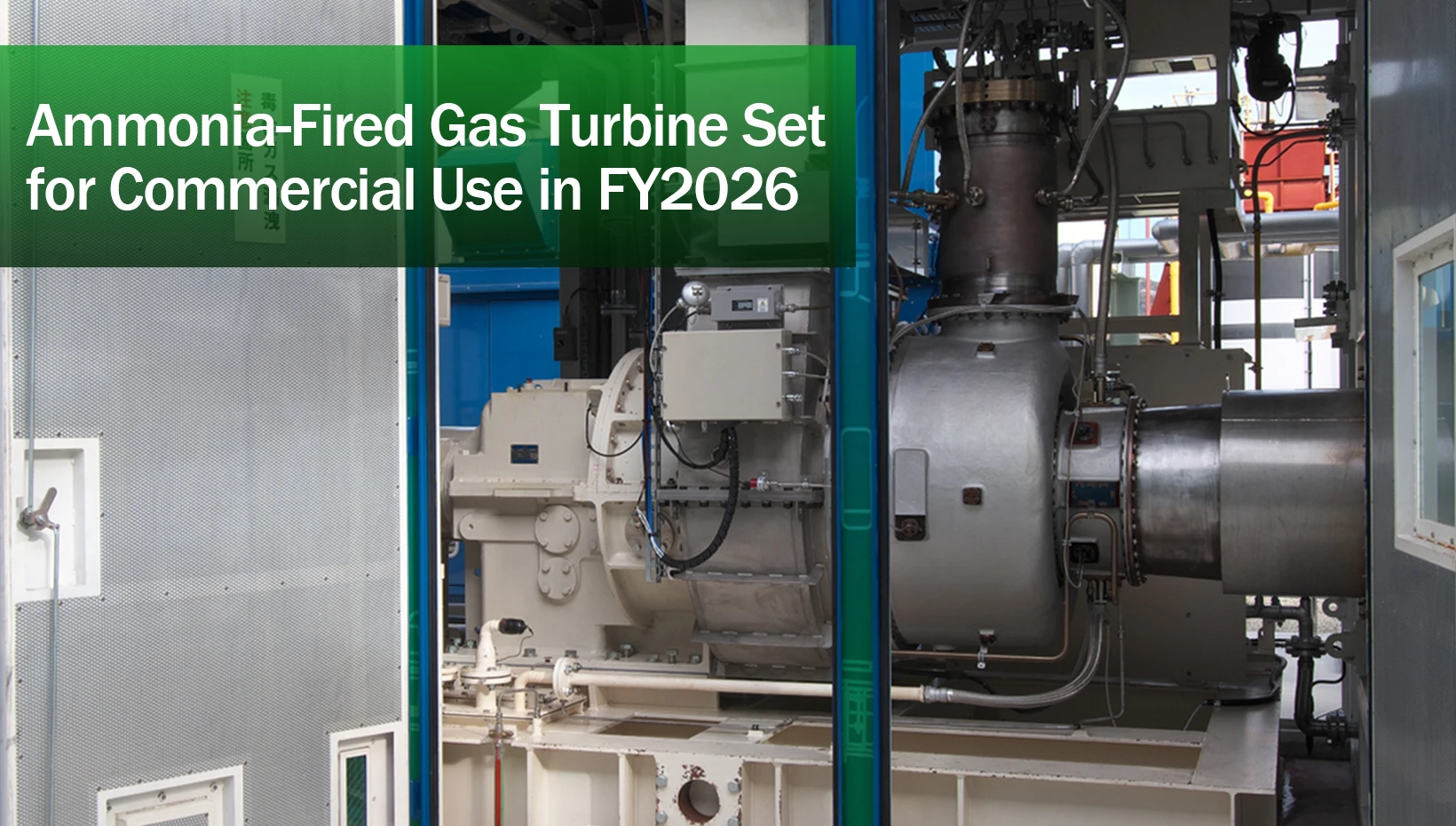
Ammonia is drawing attention as a next-generation fuel that, like hydrogen, produces no CO2 when burned. Through the Green Innovation (GI) Fund Projects, Japan’s New Energy and Industrial Technology Development Organization (NEDO) has been working to develop gas turbine technology capable of generating power using ammonia as a fuel, including systems designed to run on liquid ammonia alone. IHI, one of the companies participating in the project, has already completed demonstration tests two years ahead of schedule and is now preparing for commercial deployment targeted for fiscal 2026.
Key Technology in Place by October 2025
NEDO is promoting the “Fuel Ammonia Supply Chain Establishment” program under the GI Fund Projects. The initiative focuses on two main areas: reducing the cost of ammonia supply and advancing technologies for ammonia use in power generation, including higher co-firing ratios and mono-fuel combustion.
The decarbonization approach using a gas turbine fueled solely by liquid ammonia is one of the latter efforts. In this initiative, IHI serves as the lead company, forming a consortium with Tohoku University and the National Institute of Advanced Industrial Science and Technology (AIST) to develop the core technologies for a liquid-ammonia-fired gas turbine.
By drawing on the expertise and ingenuity of the participating organizations, the team overcame a series of technical challenges encountered during development and succeeded in establishing the core technologies by October 2025, two years ahead of schedule. The achievement made it possible to realize mono-fuel combustion of liquid ammonia—a technology long considered more difficult than using gaseous ammonia because maintaining stable combustion is more challenging with liquid ammonia.
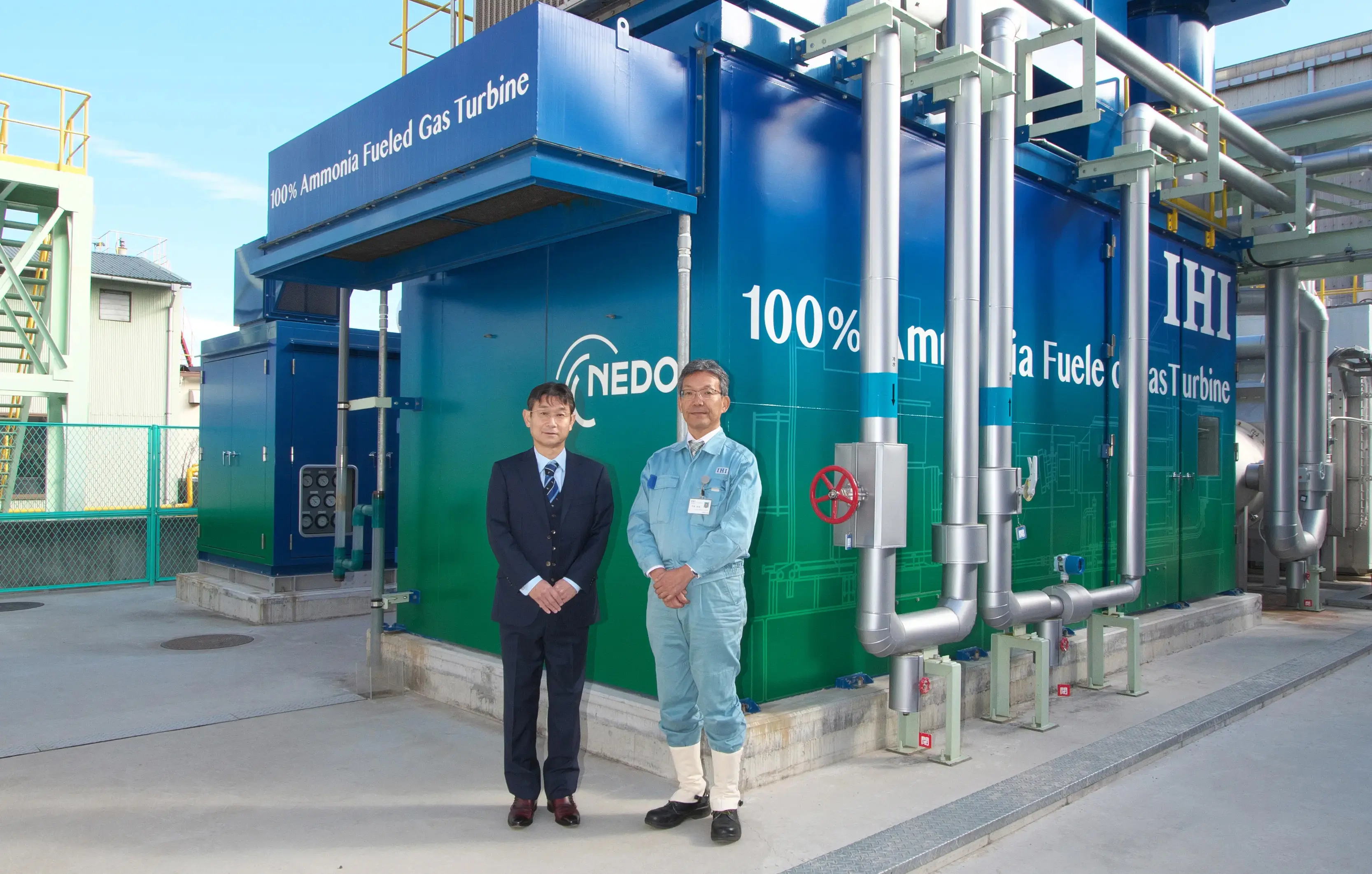
Gas turbine facility at IHI’s Aioi Works, with Yasutaka Samejima (left), NEDO project manager and head of the Ammonia Utilization Team in the Circular Economy Department, and Nobuhiko Moriya (right), associate director and general manager of the Ammonia Gas Turbine Development Department at IHI Corporation
Overcoming the Biggest Hurdle: Near-Zero Nitrous Oxide (N2O) Emissions
The greatest technical barrier to realizing mono-fuel ammonia combustion was suppressing nitrous oxide (N2O), a greenhouse gas generated during ammonia combustion. N2O has an extremely high global warming potential—about 300 times that of carbon dioxide. With conventional combustor designs, once the ammonia co-firing ratio reached around 80 percent, the CO2 reduction benefits were largely offset by increased N2O emissions.
To accelerate progress, IHI formed a consortium with Tohoku University and AIST, integrating fundamental research, mid-scale testing, and full-scale turbine development. Tohoku University and AIST were responsible for fundamental research and mid-scale testing, respectively, enabling the integrated development of a full-scale gas turbine.
As a result, the newly developed combustor reduced both unburned ammonia and N2O emissions to nearly zero compared with conventional designs, achieving more than 99 percent greenhouse gas reduction under mono-fuel ammonia combustion.
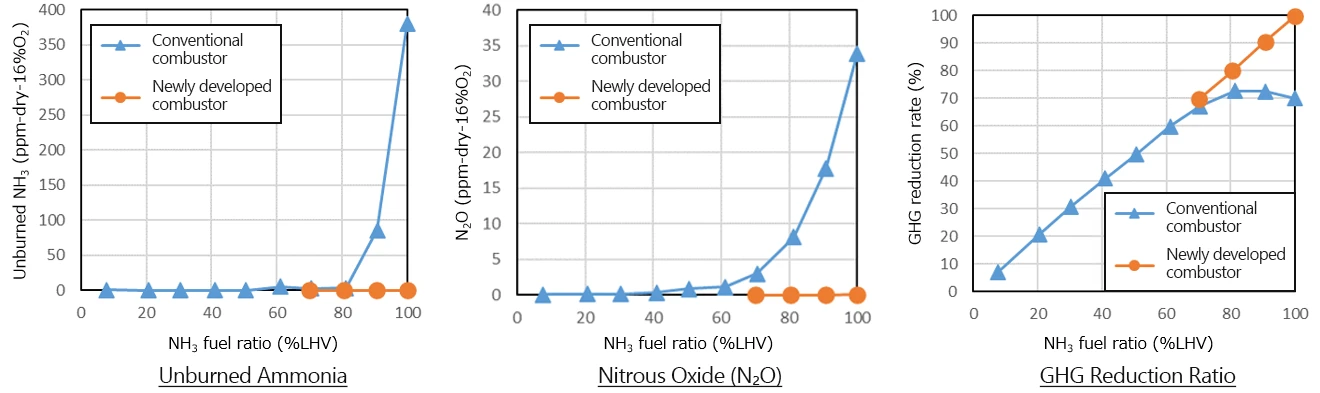
Emission and GHG reduction performance of conventional and newly developed combustors (Courtesy of IHI)
Explaining how the breakthrough was achieved, Nobuhiko Moriya, associate director at IHI and general manager of the company’s Ammonia Gas Turbine Development Department, said: “By combining advanced simulations integrating complex combustor flow dynamics, chemical reactions and temperature distribution with a rapid prototyping and validation cycle using an actual turbine—the existing 2MW class IM270 gas turbine—we succeeded in reducing N2O emissions to nearly zero, or below detectable levels, as early as fiscal 2022, just one year after the project began.”
The system also uses a direct liquid-ammonia injection approach, in which liquid ammonia is injected directly into the combustor—an approach long considered difficult because maintaining stable combustion is challenging. “This eliminates the need for large-scale equipment to vaporize the fuel, simplifying the overall system and helping reduce costs,” Moriya of IHI explained.
The project was originally planned as a seven-year initiative. However, once it became clear that these technical hurdles could be overcome earlier than expected, IHI proposed to NEDO that the development timeline be shortened by two years.
“Shortening the research plan by two years was certainly ambitious,” said Yasutaka Samejima, project manager at NEDO. “The original development roadmap called for a sequence of steps—long-term durability testing followed by combustor performance verification and improvements to safety measures and operational practices. We believed the schedule could be shortened by carrying out some of these development activities in parallel with the durability tests. After extensive discussions with IHI to revise the development plan, we were ultimately able to bring the timeline forward by two years, enabling earlier social implementation.”
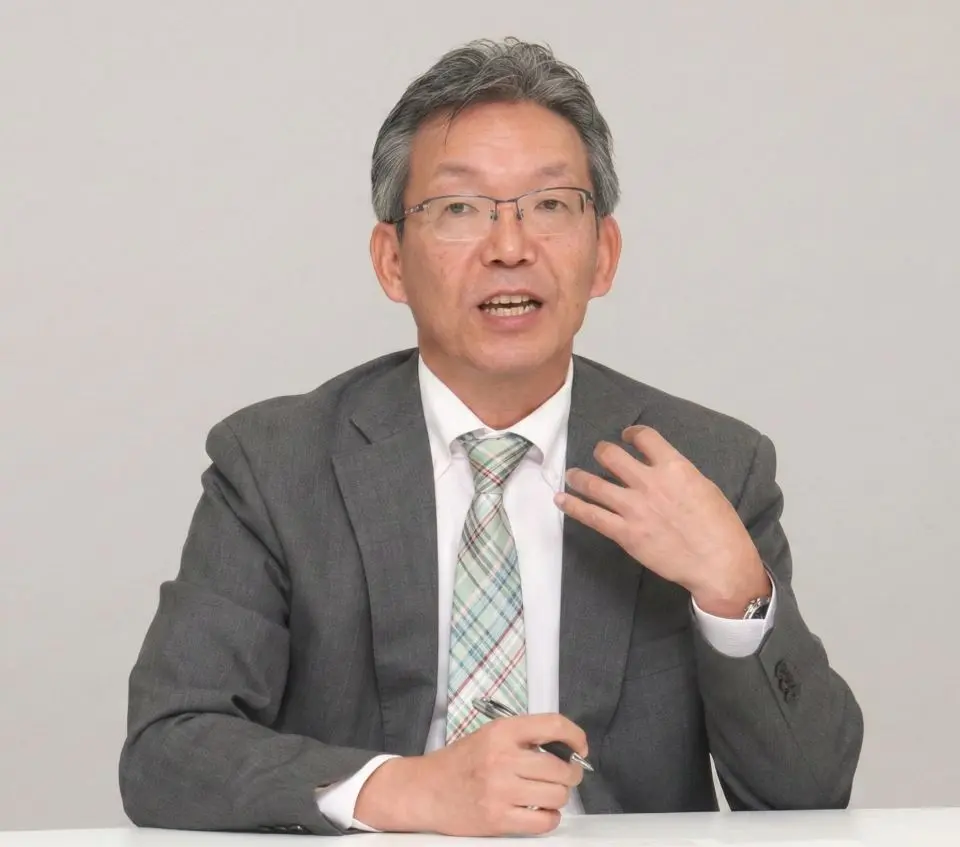
Nobuhiko Moriya of IHI explaining the development process
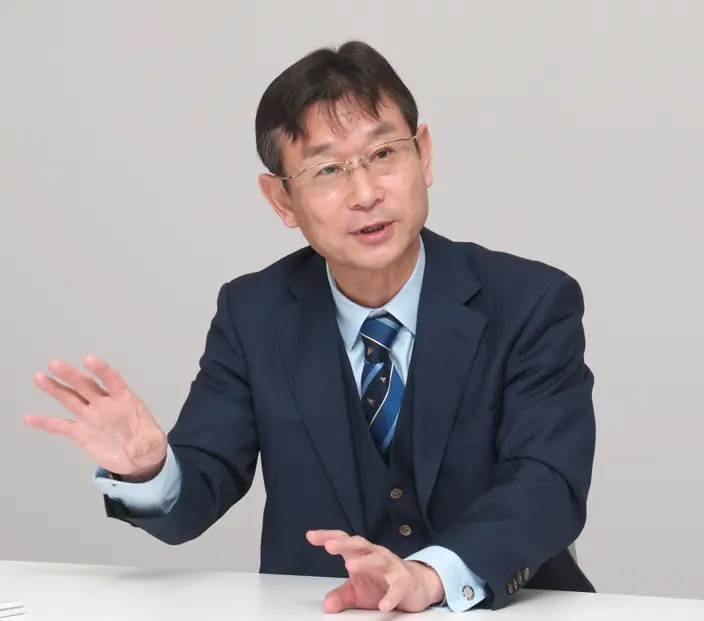
Yasutaka Samejima, NEDO project manager, discussing the management approach that enabled the project to be completed two years ahead of schedule
This flexible and proactive management approach helped maximize the speed that characterizes the GI Fund Projects, paving the way for technological achievements to move more quickly toward commercial deployment.
Durability and Safety Put to the Test Over 2,700 Hours of Turbine Operation
To bring the combustor to commercial use, following successful laboratory testing, it had to prove reliable and safe under real operating conditions. IHI conducted extensive verification tests using a full-scale facility replicating an actual cogeneration system—a combined heat and power system that produces electricity and heat simultaneously from fuel.
From June 2024 to October 2025, engineers at IHI’s Aioi Works in Hyogo Prefecture conducted a long-term durability test exceeding 2,700 hours. The system used the company’s IM270 gas turbine equipped with the newly developed combustor and operated on mono-fuel ammonia combustion. Exhaust heat was used to generate steam, replicating the configuration of a cogeneration system used at actual industrial facilities.
Electricity and steam generated by the system were used in actual production activities at the facility, demonstrating its durability under real operating conditions. The decarbonization value created by using clean fuel was also supplied to Expo 2025 Osaka, Kansai, contributing to the event’s decarbonization efforts.
After the long-term operation, the gas turbine was disassembled and inspected, with particular attention paid to damage and degradation specific to ammonia environments. The results were fed back into the design.
When handling ammonia, the system was designed according to three fundamental safety principles for potential leaks: prevention, early detection and containment. Based on these principles, rigorous safety measures were implemented. Specifically, pipe connections were welded to eliminate flanges, double-walled piping was adopted, and highly sensitive detectors were installed at locations where leaks could potentially occur. Based on these principles, rigorous safety measures were implemented. Specifically, pipe connections were welded to eliminate flanges, double-walled piping was adopted, and highly sensitive detectors were installed at locations where leaks could potentially occur.
At the same time, worker training and emergency evacuation drills were conducted, and outreach activities were carried out to foster understanding among local residents. Through these combined efforts, the project has taken a comprehensive approach to enhancing the social acceptance of ammonia utilization.
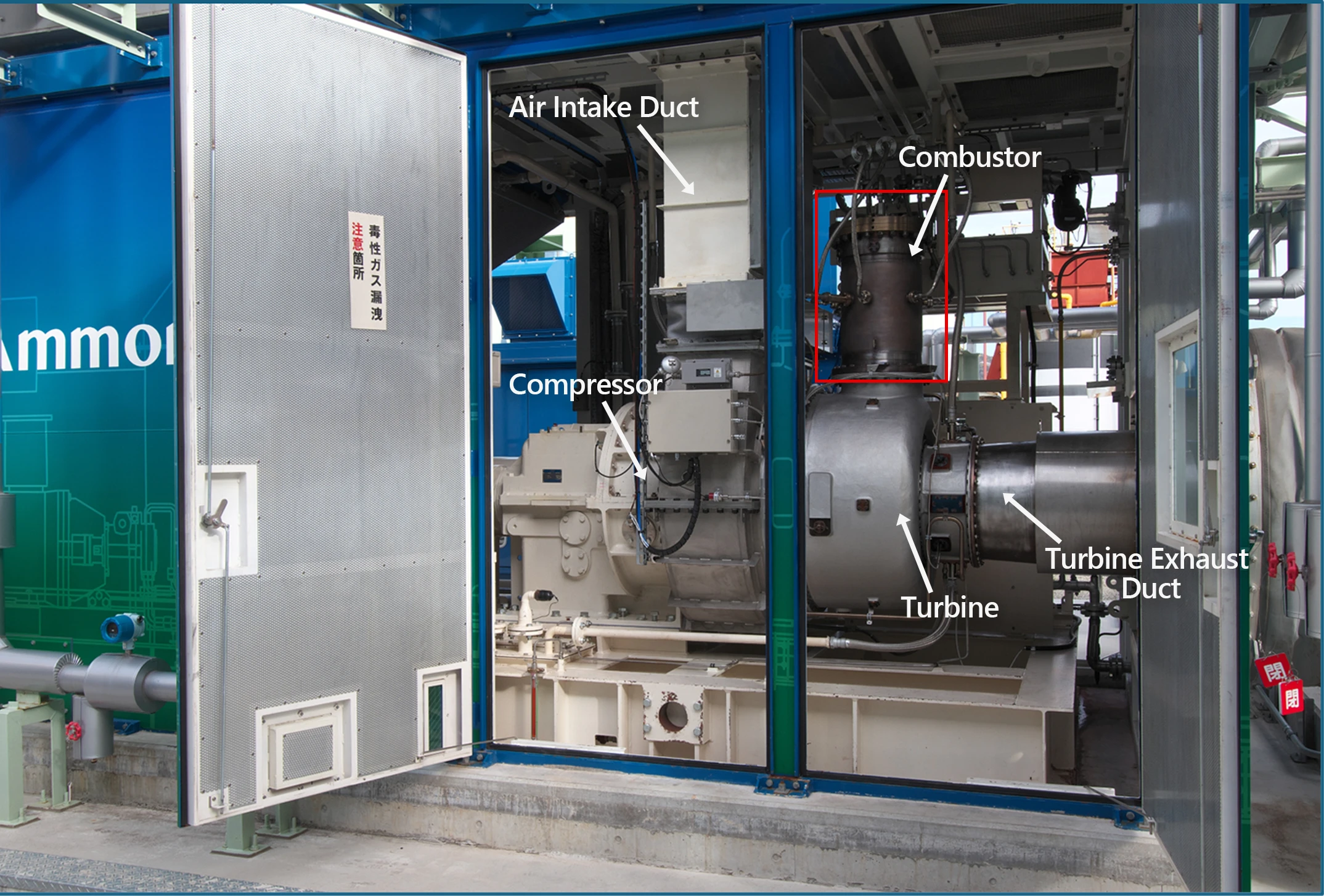
Combustor section of the gas turbine system at IHI’s Aioi Works
From mid-November 2025, IHI began further design validation testing at Aioi Works using an improved combustor, marking the final stage of development before commercialization. “Our primary focus was to further reduce NOx (nitrogen oxides),” said Nobuhiko Moriya of IHI. “At the same time, we refined the design in several areas while incorporating technical feedback, such as results from material degradation evaluations under ammonia operating conditions.
Talks Continue with Malaysia’s State-Owned Company on First Commercial Plan
The research and development of the 2MW class ammonia mono-fuel gas turbine under the GI Fund Projects will conclude in fiscal 2025, marking the transition to commercialization. The completed gas turbine is primarily intended for industrial use, targeting on-site power generation at large factories and office buildings. When introduced as part of a cogeneration system, it can efficiently supply both heat and electricity while remaining CO2-free.
However, in Japan, the infrastructure needed to handle fuel ammonia, such as port facilities and storage systems, is still under development. IHI has therefore adopted a strategy of prioritizing overseas deployment.
Under this strategy, from the research and development phase, IHI began advancing plans for a joint demonstration project with Gentari Hydrogen Sdn. Bhd., a subsidiary of Petroliam Nasional Berhad (Petronas), Malaysia’s state-owned oil and gas company. The two sides are continuing contract negotiations for the operation of the first commercial plant.
The initiative is being promoted within the framework of the Asia Zero Emission Community (AZEC), established in 2022 under Japan’s leadership. Starting with early deployment in ammonia-producing countries, the project aims to lead the expansion of a global market for ammonia-fueled power generation.
NEDO’s GI Fund Projects are designed to help participating companies move their research results into practical use as early as possible, once the technologies are sufficiently mature. “In the GI Fund Projects, we consider research and development together with companies’ business strategies,” said Yasutaka Samejima, project manager at NEDO. “The key is to demonstrate the technology as early as possible and move quickly to secure a position in the market.”
Scaling Up to Utility-Scale Gas Turbines for Power Generation
The 2MW classcombustion technology established through the GI Fund Projects will now be extended by IHI to large gas turbines used by electric utilities. In 2024, the company signed a joint development agreement with GE Vernova, a U.S.-based global gas turbine OEM, to apply the technology to turbines in the 200-300 MW class.
To ensure the successful application of the technology to large turbines, IHI has built a new large-scale combustion test facility at Aioi Works and begun combustion tests of combustors designed for GE Vernova’s large gas turbines. “Although the output of large gas turbines is more than 100 times that of the 2MW class, the combustor itself only needs to be scaled up by about two to three times,” said Nobuhiko Moriya of IHI. “That makes the technology technically feasible.”
The project’s results highlight Japan’s growing technological edge in the global competition for carbon neutrality.
“Development of the liquid-ammonia mono-fuel gas turbine under the GI Fund Projects will be completed in fiscal 2025,” said Yasutaka Samejima, project manager at NEDO. “But looking ahead to commercialization in fiscal 2026 and further expansion to larger turbines and global markets, we intend to continue working closely with IHI to ensure that this innovative technology can play a leading role in decarbonizing the world’s power generation sector.”
Building on the achievements of this project, NEDO plans to further strengthen its efforts to develop supply chains and related technologies for fuels that emit no CO2 during combustion, as part of its broader push toward carbon neutrality.