
Special Feature Decarbonizing Factories – Part 2
Combining Technologies to Offset CO2 Emissions



Part 2 of the Decarbonizing Factories series focuses on projects under NEDO’s Green Innovation (GI) Fund Projects aimed at capturing and utilizing CO2.
CO2 Capture and Local Utilization
One of the GI Fund Projects, “Development of Technology for CO2 Separation and Capture,” aims to develop technologies for low-cost, low-energy CO2 separation and capture.
The initiative focuses on low-pressure, low-concentration CO2 streams with concentrations below 10%. In plants that emit high concentrations of CO2, typically 20% or more, such as petrochemical and steel plants, CCS (carbon capture and storage) and EOR (enhanced oil recovery using CO2) have already been put into practical use worldwide.
However, capturing CO2 efficiently from low-concentration sources remains technically challenging, and the technology has not yet been fully established.
“This effort is designed to address this challenge,” says Masaaki Oki, Project Manager and Leader of the CO2 Separation and Capture Section at NEDO’s Circular Economy Department. “While the global trend toward decarbonization is expected to continue, it is unlikely that all industrial energy can be fully replaced by renewable energy. Among fossil fuels, natural gas and city gas are expected to play an increasingly important role. When city gas is used as fuel for industrial furnaces and boilers at small and medium-sized factories, the CO2 concentration in exhaust gas is typically around 7–9%. If successfully commercialized, it could make a significant contribution to carbon neutrality at these factories.”
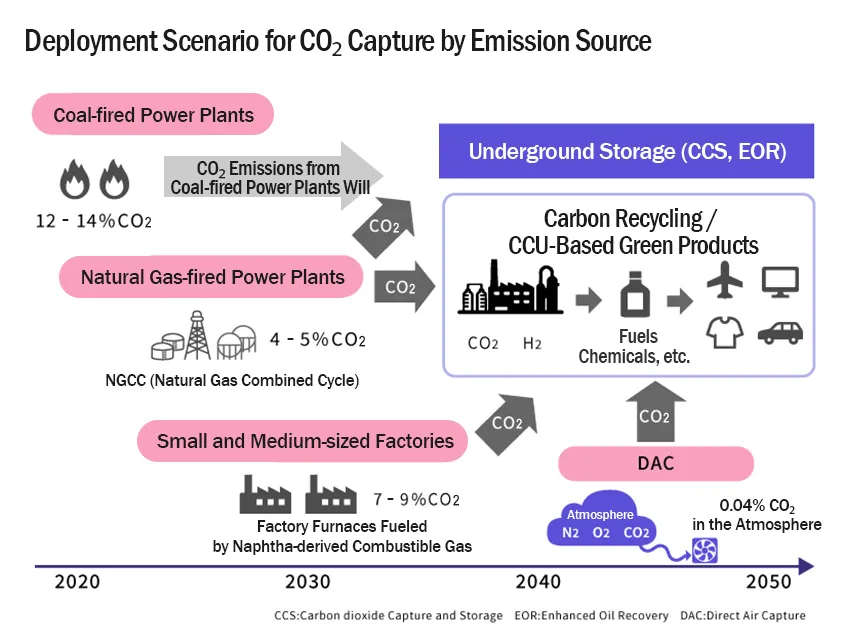
CO2 Concentration by Emission Source and Target Timeline for Capture
(Source: NEDO website, “Advancing CO2 Capture Technologies to Achieve Carbon Neutrality”)
Currently, the most widely used technology for CO2 capture is chemical absorption using amine-based solutions. However, this method requires a large amount of energy and remains costly to operate.
“With existing technologies, capturing one ton of CO2 costs about 10,000 yen. The project aims to reduce this cost to roughly one-third by 2030,” Oki points out.
To achieve this goal, multiple research groups are currently working on a range of technologies under the GI Fund Projects. These include research on metal–organic frameworks (MOFs), a research field pioneered by Susumu Kitagawa of Kyoto University, who was awarded the Nobel Prize in Chemistry in 2025. All seven projects, including the MOF project, have steadily passed their stage gates, key milestones for the program.
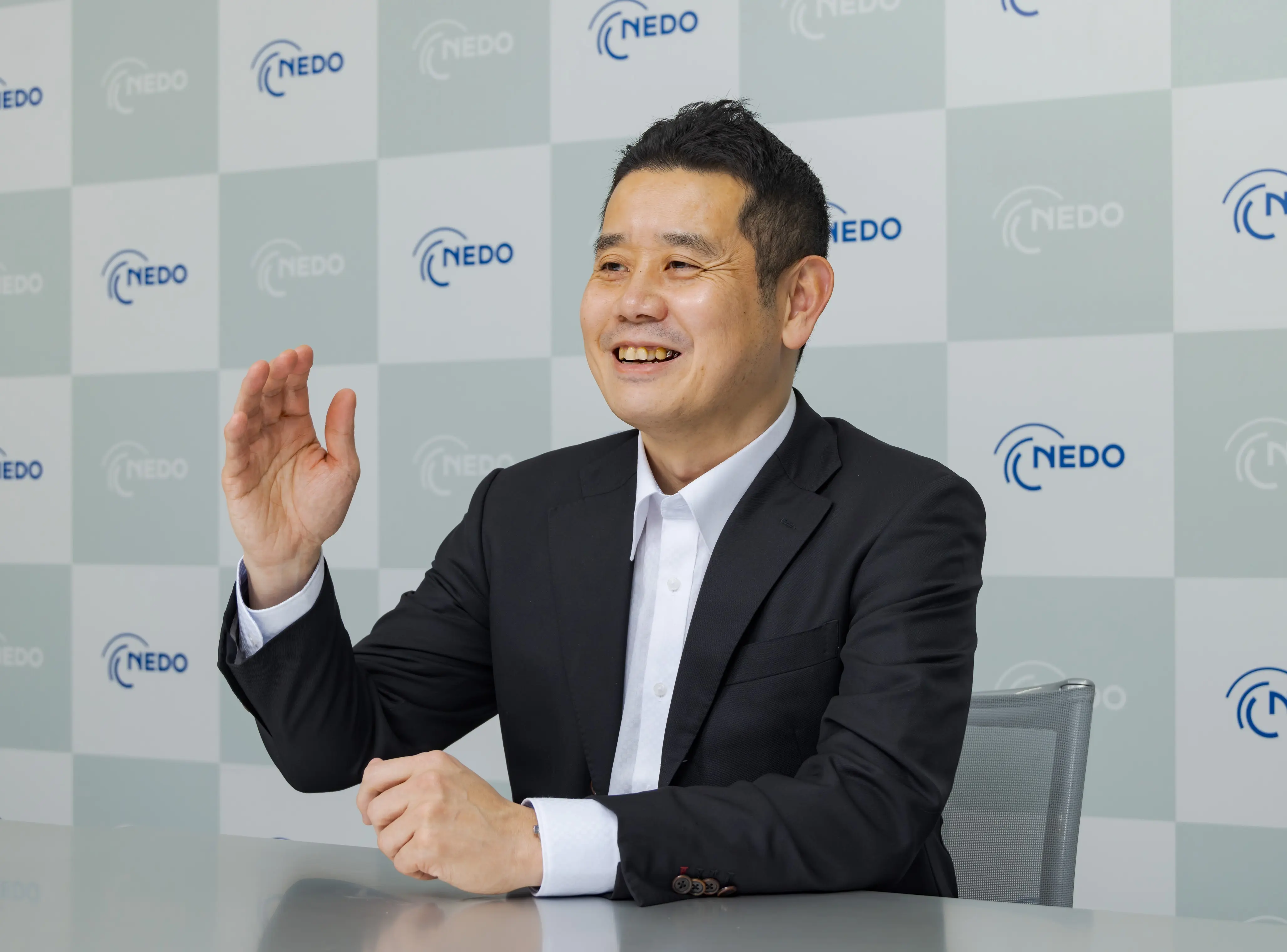
Masaaki Oki, Project Manager and Leader of the CO2 Separation and Capture Section, Circular Economy Department, NEDO
While the primary goal is to achieve low-cost CO2 separation and capture, Oki notes that the use of captured CO2 and the development of supply chains are also key issues.
“When considering the use of captured CO2, we believe the immediate focus should be on direct use as industrial gases and on applications in so-called hard-to-abate sectors, where reducing CO2 emissions is particularly difficult. While efforts are underway to reduce CO2 emissions as a cause of global warming, there is in fact a shortage of CO2 for industrial use.”
Oki adds, “During periods of high demand, particularly in summer, CO2 used for carbonated beverages and dry ice is sometimes imported from overseas, which increases transportation costs. If CO2 captured from thermal processes can be supplied as gas to nearby factories, transportation burdens can be reduced, enabling local production for local consumption and lowering costs.”
Another process cited as a hard-to-abate sector is carburizing. Carburizing is a heat treatment process used to harden metal surfaces, and because the process requires carbon, it is considered a potential application for CO2 recycling and reuse.
At Denso, a participant in the GI Fund Projects, studies are underway to convert captured CO2 into methane using methanation equipment and reuse the methane as a carbon source for carburizing.
In the future, captured CO2 is also expected to be used as a feedstock for synthetic liquid fuels produced from hydrogen and CO2.
“However, hydrogen is currently expensive, and it will likely take some time before synthetic fuels can be supplied for widespread use,” Oki notes. “Therefore, in the early stages, it is important to build a track record by starting with applications that use CO2 directly.”
Installing CO2 separation and capture equipment in existing thermal processes is not easy. The installation cost varies depending on the volume of CO2 to be processed and the concentration of the captured CO2, but it is estimated that at least several hundred million yen in investment will be required to introduce the equipment.
Meanwhile, Japan’s emissions trading system is scheduled to begin full-scale operation in fiscal year 2026. Companies that exceed their allocated emissions allowances will be required to purchase additional allowances, and if regulations become stricter in the future, direct costs are expected to increase.
Companies will therefore need to consider several options, such as continuing to pay emissions costs, investing in emissions reduction, or switching fuels.
“These technologies may not need to be introduced immediately. However, companies should begin considering their pathway to carbon neutrality and the options available to achieve it,” Oki adds. One of the aims of this project is to establish the technological foundation for such discussions.
Achieving Decarbonization through CO2-Derived Fuels
Another approach to achieving carbon neutrality in industrial thermal processes is the use of fuels produced from CO2 and other carbon-containing feedstocks. Although these fuels emit CO2 when burned, the same amount of CO2 is used during fuel production. As a result, overall atmospheric CO2 does not increase, making this approach carbon neutral in principle.
The GI Fund Project “Development of Technology for Producing Fuel Using CO2, etc.” aims to establish technologies for synthesizing carbon-recycled fuels using captured carbon as one of the options for achieving carbon neutrality.
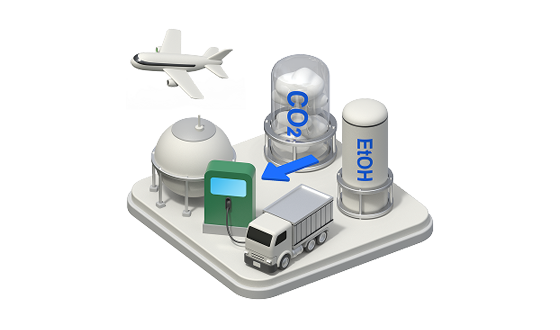
The initiative is conducting research and development on four types of fuels: synthetic fuels, sustainable aviation fuel (SAF), synthetic methane, and green LPG. For industrial applications, synthetic methane and green LPG are considered particularly promising.
One of the key features of this project is the development of fuels that can be used in the same way as existing fossil fuels. In factories, a wide range of fuels—such as heavy oil, city gas, and LPG—are used depending on the scale and purpose of operations, and the equipment varies accordingly.
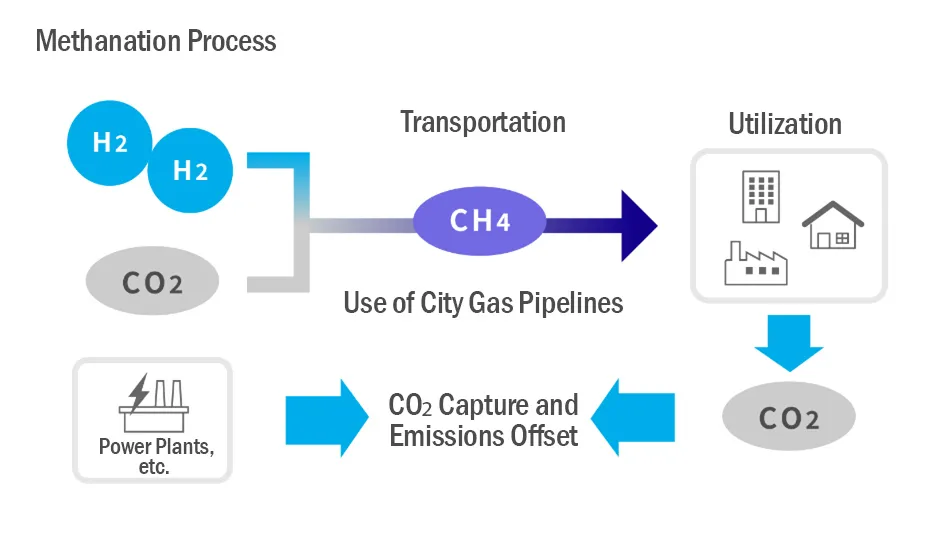
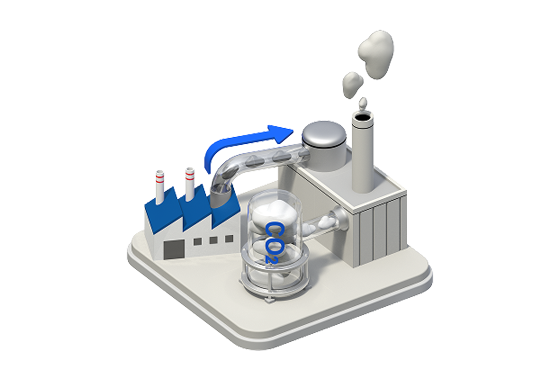
Conceptual diagram of carbon neutrality in factories using synthetic methane. Although CO2 is emitted from factories, it is reused in the production of synthetic methane, offsetting emissions and preventing an increase in atmospheric CO2.
(Source: NEDO website, “Accelerating the Development of Fuel Production Technologies Using CO2 and Other Carbon Sources”)
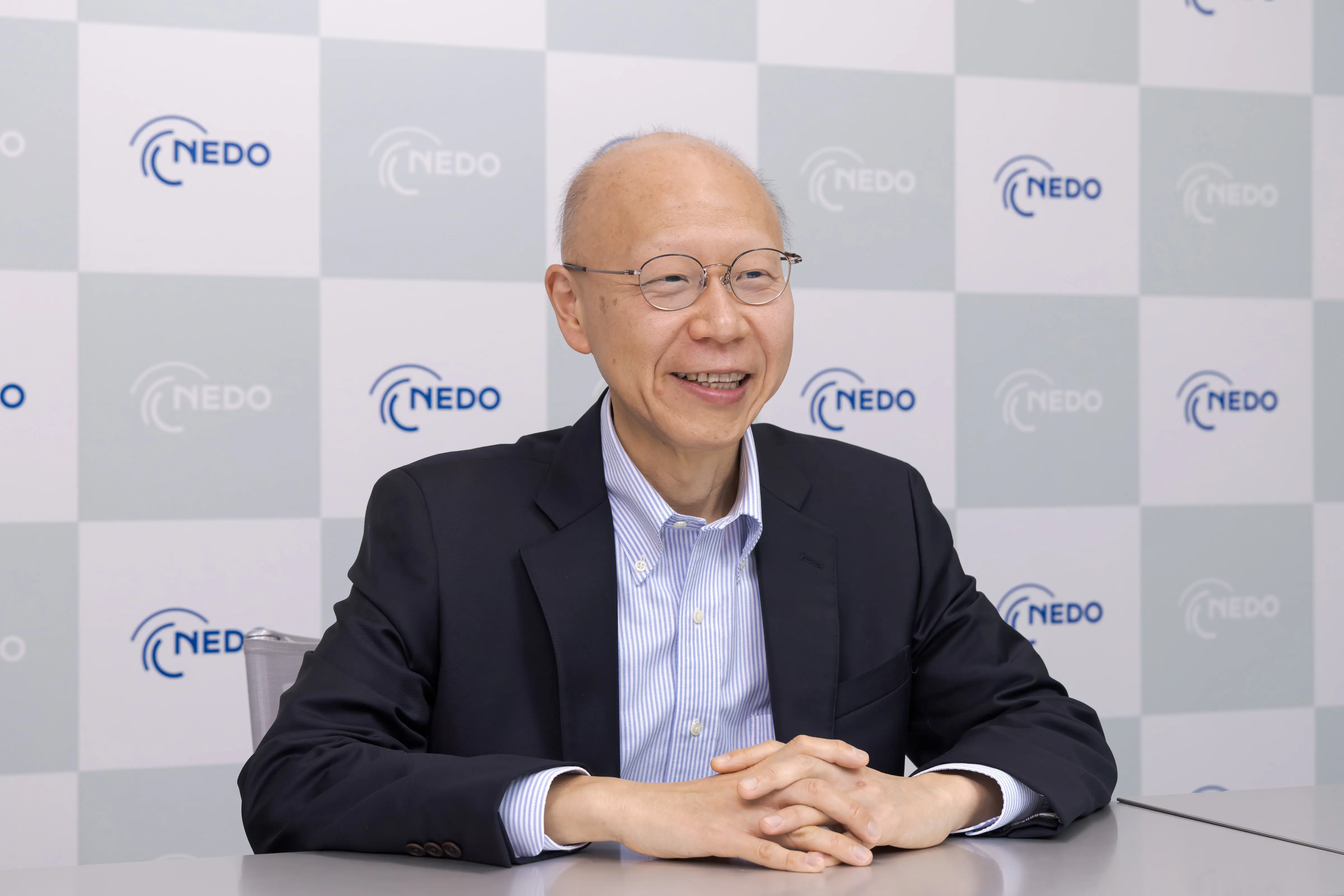
Osamu Sadakane, Project Manager and Director of Chemicals and Fuels Section, Circular Economy Department, NEDO
Because carbon-recycled fuels can be used in existing fuel systems, factories can move toward carbon neutrality without modifying combustion equipment or other infrastructure.
“They represent a promising option for achieving this efficiently without the need to replace equipment,” says Osamu Sadakane, Project Manager and Director of Chemicals and Fuels Section, Circular Economy Department at NEDO.
The ability to use existing infrastructure benefits not only users but also fuel suppliers, and ensuring this compatibility has been built into the project’s development requirements.
“These fuels are being developed to deliver the same combustion performance as current fuels, so that both users and suppliers can use them without changing the operating conditions of their equipment when they are introduced to the market,” Sadakane explains.
Synthetic methane is being developed as a substitute for city gas by two groups led by Tokyo Gas and Osaka Gas. The target is to achieve an overall energy conversion efficiency of 60% or higher for the methanation process by FY2030. The project is also pursuing a groundbreaking approach to producing synthetic methane from water and CO2 without using hydrogen, a development that is rare worldwide.
Green LPG is being developed as a replacement for conventional LPG by Furukawa Electric. The project aims to produce more than 1,000 tons by 2030 and move toward commercial production.
Carbon-recycled fuels offer the advantage that factories can move toward decarbonization simply by switching fuels. However, fuel costs tend to be higher. Without stable demand from customers, it is difficult to build large-scale plants, which in turn makes it difficult to reduce costs.
“We need to overcome this dilemma in cooperation with the government,” he emphasizes.
The ability to use existing facilities also lowers the barrier to adoption, making carbon-recycled fuels an option even for small and medium-sized enterprises. However, cost support will still be essential. Environmental value alone will not be enough to offset the higher costs, and a framework that enables continued use will be necessary.
“Using carbon-recycled fuels does not necessarily mean that complete carbon neutrality can be achieved. This is an important point to keep in mind,” Sadakane cautions.
Even if city gas is replaced with synthetic methane, CO2 is still emitted during combustion. Because CO2 is used in the fuel production process, the total amount of CO2 in the atmosphere remains unchanged. At present, renewable energy is not yet sufficient, making it difficult to reduce CO2 emissions from the production process to zero.
From the perspective of carbon intensity — the amount of CO2 emitted per unit of activity — carbon-recycled fuels offer significant environmental value compared with conventional fossil fuels. Policy frameworks are also being developed to quantify environmental value based on carbon intensity. “We hope these fuels will be recognized within such frameworks so that their CO2 reduction benefits can be properly evaluated,” Sadakane notes.
Japanese factories have achieved high productivity and quality through decades of continuous improvement. Carbon-recycled fuels represent a uniquely practical pathway toward carbon neutrality, enabling emissions reductions simply by switching fuels without fundamentally altering these highly optimized production systems.
Laying the Groundwork for Carbon Neutrality
In this two-part “Decarbonizing Factories” series, we introduced GI Fund Projects aimed at achieving carbon neutrality in industrial heat processes. As more factories move toward carbon neutrality in the years ahead, the initiatives and achievements of these projects will serve as a compass for industry. We hope readers will continue to follow their progress and outcomes.